Friday, October 20, 2006

Hero's (Christopher J Priest)


I tend to think I am where I should be. I've worked steadily in this business for 23 years now, a claim not everyone, not even some formerly powerful, fan fave giant talents, can make. It's a complete blessing, one I'm eternally grateful for, to make my living doing something I love. The "star" stuff was never a concern, and I've never once knocked on anybody's door trying to get X-Turtles or what have you. I took most of my cues from Denny O'Neil who told me, "Do nice, detailed work, be on time, stay out of trouble, do what they give you," and Larry Hama who taught me, "You learn to love what you do." And I have.


Christopher James Priest, born James Christopher Owsley in 1961, is a writer of comic books. During his career, he has written nearly every major character published by Marvel Comics and DC Comics. He was the first black man to be the editor of any comic book in North America.

For several years he was the editor of the Spider-Man comic books, during which time he first hired Peter David. He edited the Impact imprint for DC Comics. He had ongoing runs writing titles such as Power Man and Iron Fist, Conan the Barbarian, The Ray, Quantum & Woody, Steel, Xero, Deadpool, The Crew and Black Panther, some of which he either co-created or substantially influenced.

In 1993, he became part of the group of writers and artists that would go on to found Milestone Media, a comic book publisher affiliated with DC Comics. He contributed substantially to the development of the original Milestone story bible and designed the company logo. He was intended to become the company's editor-in-chief, but personal problems forced him to scale down his involvement, settling for the role of a liaison between DC Comics and Milestone Media.

Shortly afterwards, he changed his name from "Jim Owsley" to "Christopher Priest". He has refused to discuss his reasons for doing so, beyond a seemingly-glib story about carrying out a threat/promise to "become a priest". He has claimed that he was completely unaware at the time of the established British science fiction author of the same name; as an accommodation, he refers to himself professionally as just "Priest" (or sometimes "Christopher J. Priest"). Coincidentally, he is also an ordained Baptist minister, and can thus be referred to as "the Reverend Priest."

He is also a professional music producer.

From Wikipedia, the free encyclopedia

For Priest personal site and personal insites go here

For a partial list of his work go here


Play

Escher for Real

The work of M.C. Escher needs no introduction. We have all learned to appreciate the impossibilities that this master of illusion's artwork presents to the layman's eye. Nevertheless, it may come as a surprise for some, but many of the so-called 'impossible' drawings of M. C. Escher can be realized as actual physical objects. These objects will resemble the Escher's drawing, of the same name, from a certain viewing direction. This work below presents some of these three-dimensional models that were designed and built using geometric modeling and computer graphics tools. click here

Thursday, October 19, 2006

Complex Terms

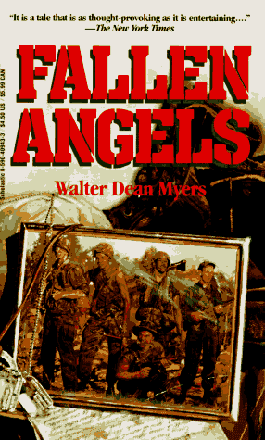
Walter Dean Myers
Fallen Angel


Reviewed by Tammy L. Currier Teens Read.com

From the mean streets of Harlem to the rice paddies and jungles of Vietnam, Walter Dean Myers's critically acclaimed FALLEN ANGELS is the riveting account of one soldier's tour of duty. Just out of high school, 17-year-old Richie Perry is fresh out of prospects. He has no money for college and the streets of Harlem are a dead-end.

Hoping for something to do, three square meals a day, and the chance to send a little money home to his mama and younger brother, Richie enlists in the army. But no one prepares him for Nam Rot…or watching your friends die…or what it feels like to kill…or the heat, humidity, and mosquitoes…or the napalm that sucks the air from your lungs at a hundred yards…or the smells of blood, cordite, burning flesh, puke and urine…or the ever-present body bags just waiting to be filled.

Graphic and realistic, Richie's first-person narrative provides the kind of immediacy lacking in most war stories. Dedicated to the older brother he lost during the Vietnam War, Myers's FALLEN ANGELS is both a tribute and testament to the thousands of young people who fought and died in the jungles of Vietnam.

Unique Perspective


Brown Plans to Make Good?

BOSTON, Oct. 18 — Extensively documenting Brown University’s 18th-century ties to slavery, a university committee called Wednesday for the institution to make amends by building a memorial, creating a center for the study of slavery and injustice and increasing efforts to recruit minority students, particularly from Africa and the West Indies.

The Committee on Slavery and Justice, appointed three years ago by Brown’s president, Ruth J. Simmons, a great-granddaughter of slaves who is the first black president of an Ivy League institution, said in a report: “We cannot change the past. But an institution can hold itself accountable for the past, accepting its burdens and responsibilities along with its benefits and privileges.” more

The report added, “In the present instance this means acknowledging and taking responsibility for Brown’s part in grievous crimes.”

The committee did not call for outright reparations, an idea that has support among some African-Americans and was a controversial issue at Brown several years ago. But the committee’s chairman, James T. Campbell, a history professor at Brown, said he believed the recommendations “are substantive and do indeed represent a form of repair.”

The committee also recommended that the university publicly and persistently acknowledge its slave ties, including during freshmen orientation. Dr. Campbell said he believed that the recommendations, if carried out, would represent a more concrete effort than that of any other American university to make amends for ties to slavery.

“I think it is unprecedented,” Dr. Campbell said, adding that a few other universities and colleges have established memorials, study programs or issued apologies, but not on the scale of the Brown recommendations. It was not clear how much the committee’s recommendations would cost to carry out.

“We’re not making a claim that somehow Brown is uniquely guilty,” Dr. Campbell said. “I think we’re making a claim that this is an aspect of our history that not anyone has fully come to terms with. This is a critical step in allowing an institution to move forward.”

Even in the North, a number of universities have ties to slavery. Harvard Law School was endowed by money its founder earned selling slaves for the sugar cane fields of Antigua. And at Yale, three scholars reported in 2001 that the university relied on slave-trading money for its first scholarships, endowed professorship and library endowment.

Dr. Simmons issued a letter in response to the report, soliciting comments from the Brown community and saying she had asked for the findings to be discussed at an open forum. She declined to give her own reaction, saying, “When it is appropriate to do so, I will issue a university response to the recommendations and suggest what we might do.”

She said “the committee deserves praise for demonstrating so steadfastly that there is no subject so controversial that it should not be submitted to serious study and debate.”

Initial reaction to the recommendations seemed to be appreciative.

“It sounds to me like this makes sense,” said Rhett S. Jones, a longtime professor of history and Africana studies at Brown. “I did not expect the committee would emerge saying, Well, you know, Brown should write a check.

“I never thought that was in the cards. I’m not sure I think it’s even appropriate that a university write a check, even though it’s pretty widely agreed on that Brown would not be where it is if it were not for slave money. These recommendations seem to me to be appropriate undertakings for the university.”

Brown’s ties to slavery are clear but also complex. The university’s founder, the Rev. James Manning, freed his only slave, but accepted donations from slave owners and traders, including the Brown family of Providence, R.I.. At least one of the Brown brothers, John, a treasurer of the college, was an active slave trader, but another brother, Moses, became a Quaker abolitionist, although he ran a textile factory that used cotton grown with slave labor.

University Hall, which houses Dr. Simmons’s office, was built by a crew with at least two slaves.

“Any institution in the United States that existed prior to 1865 was entangled in slavery, but the entanglements are particularly dense in Rhode Island,” Dr. Campbell said, noting that the state was the hub through which many slave ships traveled.

The issue caused friction at Brown in 2001, when the student newspaper, the Brown Daily Herald, printed a full-page advertisement produced by a conservative writer, listing “Ten Reasons Why Reparations for Slavery Is a Bad Idea And Racist Too.”

The advertisement, also run by other college newspapers, prompted protests by students who demanded that the paper pay “reparations” by donating its advertising fee or giving free advertising space to advocates of reparations.

The Brown committee was made up of 16 faculty members, students and administrators, and its research was extensive.

“The official history of Brown will have to be rewritten, entirely scrapped,” said Omer Bartov, a professor on the committee who specializes in studying the Holocaust and genocide.

The report cites examples of steps taken by other universities: a memorial unveiled last year by the University of North Carolina, a five-year program of workshops and activities at Emory University, and a 2004 vote by the faculty senate of the University of Alabama to apologize for previous faculty members having whipped slaves on campus.

Katie Zezima contributed reporting.

Play


Its called Complexification click here to see why

Wednesday, October 18, 2006

Protecting Your Children on a Macro Level


Its Venus Again!!!!!!!!!!
The purveyor of Cool is back again with a new Pod Cast check it out


Made Sense to me


New Rule

Bill Maher of HBO's Real Time with Bill Maher offered sobering insights about the Mark Foley scandal and the REAL THREAT to our children


New Rule: If you think the worst thing Congress doesn't protect young people from is Mark Foley, then wake up and smell the burning planet. The - the ice caps are cracking, the coral reefs are bleaching, and our poisoned groundwater has turned spinach into a "side dish of mass destruction." Read the labels on your food. It turns out the healthiest thing you can put in your body is Mark Foley's penis.

But that's America for you: a red herring culture, always scared by the wrong things. The fact is, there are a lot of creepy, middle-aged men out there lusting for your kids. They work for MTV, the pharmaceutical industry, McDonald's, Marlboro, and K Street.

And recently, there's been a rash of strangers making their way onto school campuses and targeting your children for death. They're called military recruiters. More young Americans were crippled in Iraq last month than any month in the last two years. And the scandal is that Mark Foley wants to show them a good time before they go?

When will our closeted gay congressmen learn, our boys aren't for pleasure, they're for cannon fodder? Why aren't Democrats and the media hammering away every day about who we're supposed to be fighting for over there, and what the plan is? Yes, Mark Foley was wrong to ask teenagers how long their penis was. But at least someone on Capitol Hill was asking questions.

You know who else is grabbing your kids at too young an age? Merck, Pfizer and GlaxoSmithKline. By convincing you that your kids are depressed, hyperactive or suffering from ADD. In the last decade, the number of children prescribed anti-psychotic drugs in America increased by over 400%. Which means either that our children are going insane-which we might look on as a problem-or more likely, we have, for profit, created a nation of little junkies.

So, stop with the righteous indignation about predators. This whole country is trying to get inside your kid's pants, because that's where he keeps his wallet.

I don't care - I don't care if Mark Foley had been asking boys to describe their penis because I have some sad news for you: your kid is so larded out on Cheetohs and YooHoo, he can't even see his penis. So many of our kids are fat drug addicts nowadays, it's almost as if Rush Limbaugh had puppies!

So we can pretend that the biggest threat to our children is some creep on the Internet, or we can admit it's us. Because when your son can't find France on a map, or touch his toes with his hands, or understand that the ads on TV are lying, including the one where the Marine turns into Lancelot-then the person f***ing him...is you.


Play
Simulate any of the items listed below click any item below
3DLight | Tunnel1 | Tunnel2 | Tunnel3 | Fireworks | Galaxy | StrobeCurves
Flozoids | Flozoids2 | IFSfract | Mandel | Plasma | Tmapcube | Wormhole
Acidzoomer | Arch | BrainWasher | CenterEllipse | ColorPlasma
ColorPlasma2
| CurveINfluence | EmotionalEllipses | HypnoTunnel | MagicEllipses2
Psychedelic Hypnotiser
| Qubich | QubicNewh | RandomizedEllipses
UniversalEllipses | CenterShine | Wobbler | MindBlower | Qubicbothh

Tuesday, October 17, 2006

Under the Influence

The Wire episode 43 Margin of Error
"I think the idea we're trying to bring across is that kids are going to get educated. And that we're going to see where. It's not about kids making bad mistakes and becoming caught in the Criminal Justice system. They don't have an option of choice. We in society have the choices. So you might see a kid who clearly doesn't have a prayer and it will be very apparent why he doesn't have a prayer. It's not about blaming kids. They will survive. They will learn. It's just a question of where" Ed Burns producer

Snitching, being a look out and recruited has all been subtle up until this episode
One of the statement whe nt the character Namond Brice is told by his mother "that it ws time for him to be a man he's now going to have to step up. He can't quit school, but he has to go ask Bodie for his own package" Up until this episode much of show focused on the influence (mostly negative)of men. This episode highlited the power of women from keeping a child from jail, to being the catylist for keeping a son from participating in organized sports, in this case boxing.


Street Influence
Costume Designer Alonzo Wilson. talks about dressing the young cast members of the Wire

This is a typical idea of kids on the corner, white tee shirt and jeans. White tee shirts and jeans are abundant in the world of The Wire, because of the anonymity. If you're going to sell drugs on the corner, then you don't want to be the guy in the red shirt that the police are chasing.

It's not a fashion thing. It's a functional aspect of everyday life. If you drive in the city of Baltimore in the summer, you'll run out of numbers to count the white shirts.


Influenced by Sci-Fi


Writer Stuart Moore has taken some fairly universal themes of adolescence—being the new kid at school, abusive relationships, self-esteem issues, bullying, authority figures—and deftly placed them against the exotic backdrop of outer space. But instead of overshadowing the drama, the high-stakes setting of the first colony on the moon only serves to ratchet up the tension, and makes the trials and tribulations of Earthlight's characters all the more riveting.
more

Play

It takes a lot of balls to make a video like this click

Friday, October 13, 2006

Legends (Alexandre Dumas)


I question that many of todays teens will even be interested (just saying) but they should still know who the man was

Alexandre Dumas (1802-1870)
was one of the most famous French writers of the 19th century. Dumas is best known for historical adventure novels like The Three Musketeers and The Count of Monte Cristo, both written within the space of two years, 1844-45, and which belong to the foundation works of popular culture. He was among the first, along with Honoré de Balzac and Eugène Sue, who fully used the possibilities of roman feuilleton, the serial novel. Dumas is credited with revitalizing the historical novel in France, although his abilities as a writer were under dispute from the beginning. Dumas' works are fast-paced adventure tales that blend history and fiction, but on the other hand, the are entangled, melodramatic, and actually not faithful to the historical facts.
<A HREF="http://a.tribalfusion.com/h.click/HWKLDHLIMGCQOERMMOMMEQHUPMOKPWUEFMNHHYPMPUKDSCDNNKJIDJGKPPRLQUKRBWKLDNILIIJHQFOU/1282773286" TARGET="_blank"><IMG SRC= WIDTH=300 HEIGHT=250 BORDER=0></A>

Alexandre Dumas was born in Villes-Cotterêts. His grandfather was a French nobleman, who had settled in Santo Domingo (now part of Haiti); his paternal grandmother, Marie-Cessette, was an Afro-Caribbean, who had been a black slave in the French colony (now part of Haiti). Dumas's father was a general in Napoleon's army, who had fallen out of favor. After his death in 1806 the family lived in poverty. Dumas worked as a notary's clerk and went in 1823 to Paris to find work. Due to his elegant handwriting he secured a position with the Duc d'Orléans -- later King Louis Philippe. He also found his place in theater and as a publisher of some obscure magazines. An illegitimate son called Alexandre Dumas fils, whose mother, Marie-Catherine Labay, was a dressmaker, was born in 1824.

As a playwright Dumas made his breakthrough with "Henri III et Sa Cour" (1829), produced by the Comedie Francaise. It gained a huge success and Dumas went on to write additional plays, of which "La Tour de Nesle" (1832, "The Tower of Nesle") is considered the greatest masterpiece of French melodrama. He wrote constantly, producing a steady stream of plays, novels, and short stories.

Historical novels brought Dumas enormous fortune, but he could spent money faster than he made it. He produced some 250 books with his 73 assistants, especially with the history teacher Auguste Maquet, whom he wisely allowed to work quite independently. Dumas earned roughly 200,000 francs yearly and received an annual sum of 63,000 francs for 220,000 lines from the newspapers Presse and the Constitutionel. Maquet often proposed subjects and wrote first drafts for some of Dumas' most famous serial novels, including Les Trois Mousquetaires (1844, The Three Musketeers) and Le Comte de Monte-Cristo (1844-45, The Count of Monte-Cristo). As a master dialogist, Dumas developed character traits, and kept the action moving, and composed the all-important chapter endings - teaser scenes that maintained suspense and readers interest to read more.

Dumas' role in the development of the historical novel owes much to a coincidence. The lifting of press censorship in the 1830s gave rise to a rapid spread of newspapers. Editors began to lure readers by entertaining serial novels. Everybody read them, the aristocracy, and the bourgeoisie, young and old, men and women. Dumas' first true serial novel was Le Capitaine Paul (1838, Captain Paul), a quick rewrite of a play.

Dumas lived as adventurously as the heroes of his books. He took part in the revolution of July 1830, caught cholera during the epidemic of 1832, and traveled in Italy to recuperate. He married his mistress Ida Ferrier, an actress, in 1840, but he soon separated after having spent her entire dowry. With the money earned from his writings, he built a fantastic Château Monte cristo on the outskirts of Paris. In 1851 Dumas escaped his creditors - his country house, the Chateau de Monte Cristo. Dumas spent two years in exile in Brussels (1855-57), and then returned to Paris. In 1858 he traveled to Russia and in1860 he went to Italy, where he supported Garibaldi and Italy's struggle for independence (1860-64). He then remained in Naples as a keeper of the museums for four years. After his return to France his debts continued to mount.

Called as "the king of Paris", Dumas earned fortunes and spent them right away on friends, art, and mistresses. Dumas died of a stroke on December 5, 1870, at Puys, near Dieppe. His son Alexandre Dumas fils, became a writer, dramatist, and moralist, who never accepted his father's lifestyle.

Dumas did not generally define himself as a black man, and there is not much evidence that he encountered overt racism during his life. However, his works were popular among the 19th-century African-Americans, partly because in The Count of Monte-Cristo, the falsely imprisoned Edmond Dantès, may be read as a parable of emancipation. In a shorter work, Georges (1843, George), Dumas examined the question of race and colonialism. The main character, a half-French mulatto, leaves Mauritius to be educated in France, and returns to avenge himself for the affronts he had suffered as a boy.

Works by Dumas

Play
You Got the Right Stuff Baby, Uh Huh!


This fuzzy video was a series of Sprite commercials was one of the first to combine the elements of hip hop and anime the results are very pleasing


Thursday, October 12, 2006

They Said It Not Me


A Review of Miracle Boys by Jacqueline Woodson

Oh man! I loved this book Miracle's Boys. This book is definilty a classroom classic. Now I dont want to be a spoiler, but this book is about three boys who live in Harlem and are growingup on their own. Their mom died of diabetes and their father died trying to save someone else. I'm not going to tell you anything else, you just have to read the book! So read this teriffic book and you will look at life an entirely different way. A Carefree Read", October 4, 2006

I must say this book didnt particularly catch my intrest at first, but after reading the description o the back, i thought it would be cool. Boy was i wrong. This book had a good story but was very slow! I mean theres barely any action and good teen drama in it!So to sum it up.... This book was a little less than OK.
sincerely
THE BOOK BANDIT

p.s yes i DID see the special for this book on THE-N and i thought it was ALOT better than the book (suprisingly).

A Kid's Review
the reason why i like the book miracles boys is that it is based on an african american family living in harlem new york. the family is run by their 18 year old brother tyree. they are all borthers. one "the youngist" is lafayette, the middle child" charley and the oldest brother tyree. their parents are both dead. their dad died in a freezing cold pond trying to save a ladys dog. their mom died in a car crash. the middle brother charley was sent to a juvinile detention center for robbing a store. this book is a great book because it has a lot of action and suspense.

I Truly Pity the Fool
I started the week talking about pitiful African American Male characters on TV, well the future is not much brighter not if TV land has anything to do with it

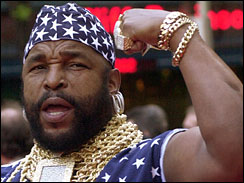
(CBS/AP) If Dr. Phil can dispense advice, why not Mr. T?

The TV Land network announced today that it will start "I Pity the Fool," a series where "The A-Team" star travels across the country dispensing inspiration and advice.

In an interview with The Associated Press, Mr. T. said that "the 'T' stands for talking." And that's what he's going to do: "talk it up."

In the series, which debuts in October, Mr. T will offer help to people struggling with personal or professional problems.

The former TV star rejects any comparisons with Dr. Phil, adding: "You're a fool — that's what's wrong with you. You're a fool if you don't take my advice."

Mr. T was born Laurence Tureaud in Chicago, Ill. He was a pro wrestler in the '80s and '90s, often sparring with Hulk Hogan. He became a household name when he appeared as a regular character on the hit show "The A-Team," which premiered on NBC Jan. 23, 1983.

"I Pity The Fool" will be produced by Lionsgate in association with Left/Right Films and Remag Guerilla.

Play


Challenge your mind with brain exercises ranging from simple math problems, reaction tests,
memory and other fun brain exercises. Play these brain exercises once a day, register with
BRAIN TRAIN and we will chart your progress. Compare your results to track improvement more

Wednesday, October 11, 2006

My sistas, you have already worked too hard to blow away your dreams.


Oh My God ! Its Venus Again


Venus is back with another Pod Cast click here only if you want to hear cool

Global Teens Growing

Indifferent

to "Brand America"


Over at Adbusters. Org they featured an article on how there seems to be a great ambivalence towards America among global teens.

While none of this spells out-and-out doom for US brands, being forced to stop drinking from the poisoned well has left marketers scrambling to uncover new formulas for generating teen cool...more


The Influence of Positive Black Women


I found these comments at Teen Voice and it was incredible to hear what young sisters had to say about themselves as defined by their feelings not the media's negative bull_ _ _ _!

Collage by Gladys Fashote, 14, Massachusetts Sable Bing, 17 Georgia

Black women are more than just attitudes, sexual visions, and the loud mouths the media makes us out to be. Some people may think that finding respectable black women in the media is like searching for a needle in a haystack, but there are black women in this industry who stand by their morals and who hold important positions in our communities. Some of these women take into consideration that young women, especially teenagers, may watch them and they try their best to show responsibility, honesty, respect, and positive leadership.

Monica Kaufman is an example of a distinguished black woman in the media. She is a news anchor in Atlanta, Georgia with WSB-TV Channel 2 and also does television specials. Kaufman is an encouraging figure in the media and she gives black teen women hope that they can achieve any goal that they set.

Many women in the music industry wear skimpy clothes and use the motto "sex sells." Unlike the majority, Alicia Keys stands out without having to use sex to sell an album. She relies on her talent and shows teens that using sex appeal is not the only way to make it in the music industry. Keys also helps the community by contributing to a national AIDS campaign to create awareness about the virus. She inspires teen women to feel comfortable without feeling pressured to have sex and to use their mind to attain success.

Another woman of color who is not only successful in the media, but also gives back to the community is Oprah Winfrey. Long-time talk show host and one of the richest people in America, Winfrey helps people around the world with her Angel Network. Winfrey also pays for the education of 200 scholars at Morehouse University in Atlanta, Georgia. She inspires teens and gives them the will to accomplish any goal with a lot of hard work and overcoming the negative attitudes of others.

Monica Kaufman, Alicia Keys, and Oprah Winfrey are examples of women in the media who follow their moral standards and deliver a positive image to audiences across

Black Women are Dignified

Nneka Obiekwe, 15
Georgia

Black women are dignified, family oriented, intelligent, and rooted in their faith, but they are not always portrayed this way in the media. When thinking about black women in the media, one would imagine the women who choose to trade in their names for the label "video ho" in order to get a spot in front of the camera. They have no identity, and they suggest that their only skill is to shake their butts and flaunt their bodies. These girls bring shame upon themselves and black women. Yet, they supposedly reflect black women. The public has a natural inclination to take notice of the negative, rather than the positive. One bad move can ruin the reputation of an otherwise successful career, or in this case, an otherwise positive group of people.

We have very strong and influential leaders in the black community who make me proud to say that I am a black female. These women should be a prominent reflection of our black women, but their message—that beauty is not just skin deep and that intelligence can be sexy—is often overshadowed by the video girls who send a more glamorous message, which suggests black women use sex appeal as a tool to get men, cars, and clothing. These video girls are the women who do whatever it takes to get their fifteen seconds of fame. Nevertheless, the true message sent by these actions is that by compromising self-respect and dignity, you can receive negative attention and serve as the models of what most black teens don't want to be.

Black Women Negativity

Briana Williams, 13
California

Over the years our people have changed,
from the way we dress to the way we say our names.
Black women have come so far,
from being mistreated to becoming doctors.
There are so many black women today trying to be something in life,
yet, some of them make money the wrong way and don't do what's right.
Our people are misjudged because of the negative images they see on TV,
and so now positive people are suffering because they know others won't want to see
how much we can do in life,
how much we can become.
We want to show others that we are the ones
who deal with our fellow sistas who dance on TV
so provocatively,
next to unknown men and women,
to earn a quick dollar,
So I try to holler out to my fellow sistas who want a bit of money and fame,
nothing is wrong with happiness,
but you don't need a weave in your hair,
you don't need to shake that thing like your mama taught you,
in front of men who won't care about you.
You don't need to be ghetto fabulous.
Instead, do what comes naturally
because, my sistas, you have already worked too hard to blow away your dreams.


Play
ZeFrank is at it again with the Scribbler
more

Tuesday, October 10, 2006

Alfred Tatum Revisitied

NIU literacy professor works to close reading achievement gap for African-American adolescent males

DeKalb — As a young teen in the Chicago Public Schools, growing up in a poverty-stricken neighborhood a few yards from a federal housing project, Alfred Tatum became one of the fortunate ones.

He was blessed with empowering teachers who understood his surroundings. They cared about his life and not only his test scores. They encouraged him to read Dick Gregory's “Nigger” and “The Autobiography of Malcolm X.”

Such passion for teaching – “Harvard dreams for kids living in hellish conditions,” Tatum says – made a difference: Tatum is now an NIU professor of literacy education with a Ph.D. in curriculum and instruction.

Yet his good fortune “is part of the problem,” Tatum says. “Children should not be fortunate to have quality teachers. We're not playing the lottery with lives.”

Tatum's book, “Teaching Reading to Black Adolescent Males: Closing the Achievement Gap,” released in May by Portland, Maine-based Stenhouse Publishers, is earning great attention among U.S. educators and netting several speaking engagements for the busy author.

Meanwhile, the mounting weight of the federal No Child Left Behind law and its focus on test scores is fueling Tatum's insistence that a successful school experience involves more than good grades.

“My phones have been lighting up since this book came out,” says Tatum, who also is an NIU alum. “Teachers want to know how to address these issues, but they feel handicapped by limited experience … or they feel powerless because they attribute it to factors they cannot control, such as parental involvement or poverty. They shift the responsibility.”

Tatum already has spoken to school teachers and administrators in Michigan , New York , New Jersey and Ohio .

In his home state, he has visited his alma mater Chicago Public Schools, where he began his career teaching eighth-grade for five years on the city's South Side. He also accepted an invitation to speak from the suburban Oswego school district, where “the other students” are succeeding.

He also has written a two-part article for Middle Level News, published by the California League of Middle Schools.

“It's a point of urgency. We cannot continue to stay the course we have been on for African-American adolescent males,” he said. “We need to rally people around the complexity of addressing the literacy needs, not only of African-American adolescent males, but of all students in the face of national legislation.”

Tatum's concerns are many.

No clear strategy has emerged for addressing the needs of African-American adolescent males, including the lack of a clear definition for the role of reading in their education.

Policy makers and educators focus more on instructional strategies and ignore other issues that affect learning, such as poverty or the cultural disconnect of the classroom.

Such a lapse makes for an “anatomically incomplete” body of teaching, he says, missing the head (the theoretical) and the legs (the professional development).

Many African-American adolescent males also experience an “out-of-school literacy overload and an in-school literacy under-load,” he says. They live amidst race- and class-based “turmoil” before and after school while their teachers fail to provide the texts that could “serve as road maps” to better life outcomes.

As a result, Tatum posits, the disengagement of these young minds and their disproportionate (and often inappropriate) referrals to special education services lead to their 50-percent high school dropout rate in some of the nation's largest urban school districts.

Their resistance to reading anything – whether to satisfy academic, culture, social or emotional needs – rises as they are assigned texts “that inadvertently contribute to their diminished status in schools and society.”

Rather, Tatum says, teachers should encourage interest in school through reading assignments that reflect their own situation and provide them hope to rise above their circumstances. “Young African-American men need to be reading more text,” he says, “not less.”

Teachers of African-American adolescent males need “the 4 Cs,” he says: compassion, competence, commitment and cultural responsiveness.

He urges these considerations in the selection and discussion of texts with African-American adolescent males:

  • Establish a broader definition of literacy instruction that guides the selection of text. It must focus on skill and strategy knowledge, content knowledge and identity development. “It is imperative that these young men have the requisite skills to read text independently. It is also imperative that they become ‘smarter' as a result of their reading,” he says. “It is essential that literacy instruction helps these young men form an identity that allows them to resist some of the negative community forces that are part of their day-to-day realities.”
  • Identify a core of “must-read” texts for African-American adolescent males. These include James Baldwin's “The Fire Next Time” and Ralph Ellison's “Invisible Man.”
  • Discuss texts in culturally responsive ways. “Students benefit when they can extend the ideas contained in texts into their own lives,” he says.
  • Identify texts that balance the out-of-school literacy overload. “Most of the texts they should be exposed to are co-opted by schools' focus to improve reading scores,” he says. “Black males are not exposed to text that leads to academic, cultural, economic and social uplift.”
  • Examine your disposition toward using texts with African-American adolescent males. Many teachers back down when they encounter resistance from their students to read beyond the required material, Tatum says. “However, no research currently shows that having students read less advances their academic and other literacy needs.”

In Tatum's case, reading the works of Dick Gregory, Richard Wright, Booker T. Washington and others “released me from a stigmatic trapping of poverty. My teachers connected text to my life,” he says. “It's really something I didn't forget.”

Play

My how time flys (in honor of Google buying YouTube)


Monday, October 09, 2006

The Stench of Exploitation

The Wire Episode 42


Late night in a rear alley, Dukie leads Michael and Randy to the vacant house he spied Chris escorting one of his victims. Prying the plywood off the door, they creep inside, making their way to the decaying bodies in the back of the house. "He dead," Dukie says, pulling away the plastic cover. "They all is." As they file out, Dukie proves his point to Randy, who, still childlike in many ways, seems relieved to know that they are not, at least, zombie spies ready to haunt his dreams. "There ain't no special dead," says Dukie. "There's just dead." There are various stories unfolding in the Wire, butthe storylines that depict the young males, all from vsrious backgrounds losing their innocents as they are slowly devoured by the system are the most chilling, What becomes painfully evident is that these young men have very few options and none that have promise. Not a warm and fuzzy thought, but one we can do something about

The Stench of Exploitation

There's more proof that Neil Postman knew what he was talking about.

In his 1985 book, Amusing Ourselves to Death: Public Discourse in the Age of Show Business, the media critic and educator suggested that futurist Aldous Huxley, not George Orwell, had a better vision of where life on this planet is headed.

What Orwell feared were those who would ban books, Postman wrote in the foreword to his book. What Huxley feared was that there would be no reason to ban a book, for there would be no one who wanted to read one. … Orwell feared that the truth would be concealed from us. Huxley feared that the truth would be drowned in a sea of irrelevance. Orwell feared we would become a captive culture. Huxley feared we would become a trivial culture.

The success of Flavor of Love 2, a VH1 reality show whose second-season premiere last month brought the cable network its highest rating for any opening show, is a crass and tasteless descent into the abyss that Huxley saw the world hurtling toward. And it is proof positive that this nation is at risk of amusing ourselves to death.

The show is built around Flavor Flav, an aging rapper whose real name is William Drayton. A classically trained pianist, he found stardom as a member of Public Enemy, a rap group

It also offers us the kind of caricature of black men that makes Stepin Fetchit and the Amos 'n' Andy character Algonquin J. Calhoun look like straight men. With his ever-present mouth full of gold teeth and oversized clock that hangs around his neck, Flavor Flav is a cartoonish figure that only a mother or VH1 would believe might be hotly pursued by women with an IQ above room temperature.

On one level, his buffoonery is laughable. But more often than not it makes my skin crawl to know that as Lincoln Perry (who played Stepin Fetchit) and Johnny Lee (who was TV's Algonquin J. Calhoun) did, Drayton has to assume such a shallow black role to find stardom in Hollywood.

If you think Flavor of Love 2 is innocent television fare, you're wrong.

We do not see nature or intelligence or human motivation or ideology as it' is but only as our languages are,Postman wrote. And our languages are our media. Our media are our metaphors. Our metaphors create the content of our culture.

And shows such as Flavor of Love 2 dumb us down and define us to others in ways that ought to cause an awful churning in our national gut. to read the entire artlce click here

Don't watch this show, and if you do, don't let your teens watch you watching this show


Money Matters

Parents of University of Minnesota students are signing up this fall for their own course, one they hope will teach them tools to help their children manage money. click here to read more

Play

Need the sound for a car beeping and don't know where to find it

click here to go to find a sound dot come

Friday, October 06, 2006

Legends (Ezra Jack Keats)


Growing Up with Peter
EZRA JACK KEATS
1916-1983

Benjamin Katz and Augusta Podgainy were born in Warsaw, Poland. However, they did not meet until they had both emigrated to the United States. Continuing the Polish custom, their wedding was arranged by a matchmaker. After the marriage, the two settled in the Jewish quarter of Brooklyn, New York. In a two-family house at no. 438 Vermont Street, their third child, Jacob Ezra Katz was born on March 11, 1916.

At an early age, Jacob, known later to the world as Ezra Jack Keats, became interested in art. His mother encouraged Keats' talent, but his father seemed only to criticize Keats' ability. Working at Pete's Coffee Shop in Greenwich Village, Benjamin Katz knew how hard earning a living could be. He felt that his son could never really be successful as an artist. However, his father did purchase tubes of paint for Keats under the pretense of having traded bowls of soup to starving artists. "If you don't think artists starve, well, let me tell you. One man came in the other day and swapped me a tube of paint for a bowl of soup."

Keats did win the approval of his father when he was paid twenty-five cents for painting an advertisement for a local store at the age of eight. Finally, Benjamin thought his son might be able to earn a living with his art, as a sign painter.

When Benjamin Katz died on January 1935, Keats, on the day before his high school graduation,

had to identify his father's body. For the first time he learned that his father had been proud of his work. In his Caldecott Medal speech in 1963, Keats shared the experience. "I found myself staring deep into his secret feelings. There in his wallet were worn and tattered newpaper clippings of the notices of the awards I had won. My silent admirer and supplier, he had been torn between his dread of my leading a life of hardship and his real pride in my work."


Keats worked on a book featuring a little boy named Peter. Peter was inspired by an article Keats had clipped from Life magazine in 1940. "Then began an experience that turned my life around--working on a book with a black kid as

hero. None of the manuscripts I'd been illustrating featured any black kids--except for token blacks in the background. My book would have him there simply because he should have been there all along. Years before I had cut from a magazine a strip of photos of a little black boy. I often put them on my studio walls before I'd begun to illustrate children's books. I just loved looking at him. This was the child who would be the hero of my book."

The book featuring Peter, The Snowy Day, received the Caldecott Medal for the most distinguished picture book for children in 1963. Peter appears in six more books growing from a small boy in The Snowy Day to adolescence in Pet Show.

Keats authored and/or illustrated more than 85 books for children. In 1980, he was awarded the University of Southern Mississippi Medallion for outstanding contributions in the field of children's literature.

Keats link

Keats Link


Play
Enter a book you like and the site will analyse our database of real readers'
favourite books (over 20,000 and growing) to suggest what you could read next

What to read next
http://www.whatshouldireadnext.com/books/search


Thursday, October 05, 2006

Sound, Vision & Good Reads

Who is the Black Panther?
With the exception of Spiderman and Silver Surfer, Black Panther is one of the coolest creations to come from the minds of Jack Kirby and Stan Lee. An African King ruling in a country light years ahead of everyone else was an incredible concept. Great concept but it never went forward. Years later other writers tried their hand at Black Panther never able to capture the essence of the character. (My mind still has the image of BP being burned on a cross by the KKK etched into my mind, Thanks Mr. Don McGregor, do you think anyone black would’ve wrote something like that?)
When Christopher Priest introduced the Black Panther in 1998 he created the foundation that BP's future would be built on. (inclding the Huddlins current run)
BP was no longer a loyal, jovial team player but a King that was a master strategist always looking for angles that would benefit his nation, in most cases BP was several steps ahead of all of his opponents
Priest also understood the idea of an African ruler of an advance nation spending all of his time fighting bad guys in America’s ghettos was at best stupid, at worst insulting. Wakanda became the focal point of the series not the character. Priest's BP was not written for kids, the storyline were filled with multiple plots changing timelines and filled to the brimmed with political intrigue, in short it was as dense as an episode of HBO's The Wire. But like the Wire that is often compared to the Soprano’s and Star Trek Deep Space 9 that is compared with TNG. History will reflect on Priest run hailing it as an accomplishment along the same lines as Frank Miller's Dark Knight and Alan More's The Watcheman
Check out his trade paperbacks the Client and Enemy of the State


Radio No Longer for the Masses (they're not paranoid)

Click here to hear how Corporate Giant Clear Channel used its muscle to prevent a song that encouraged youth to both register and get out to vote from being aired click here


Play

Yeah another Honda Commercial, and Yeah its another good one click here

Check out Breathing Earth and Get Active Click here

Wednesday, October 04, 2006

Hyphy & the Little Shop of Horrors


The Horrors

I referred to Congressman Foley as a Vampire
Senator Allen as Dr Jeckell and Mr Hyde
and our inner city youth as Frankenstien monsters
after watching yesterdays episode of I'll blame anyone just as long as I stay in power, I can only refer to the Congress as a shop of horrors

This Lizard knows Hyphy

Venus the water dragon does a weekly music blog which I will beging offering here, each Pod Cast features her list of top 5 songs
So if you want to know what cool music sounds like just click below


link

Sunday Night Jam Sessions


Music in the Classroom
Andre 3000Outkast’s Andre 3000 (Andre Benjamin) unveiled his new animated series “Class Of 3000” at a recent Cartoon Network press event, set to debut in November.

Andre explained that the cartoon revolves around a group of gifted music students who look up to former graduate-turned superstar Sunny Bridges, voiced by Dre. One of the characters, Lil D, is loosely based on Dre’s childhood.

“I come from the projects and [I used to] go all the way across town to school, which is in Buckhead, a prominent part of Atlanta,” said Dre. “I went to school with mayor’s kids and commissioner’s kids, so it was a mash-up then. One of my best friends, he was French. Another best friend was Indian.”

“So when we created show, we didn’t want it to be just all Black characters or all White characters,” he said. “We just created a world and it kind of mirrors what’s going on right now. Everybody hangs out with everybody. It’s not like you just stay in your own little clique. There’s a huge Crayola box going on.”

Andre says he’s also looking to drop a soundtrack for the series, and is already searching for artists to make guest appearances during the show’s second season.

"We're reaching out to a lot of people," Dre said. "A lot of people are interested. Every time you drop an album, you kinda go through this whole run. You do TRL, you do all those shows. I think 'Class of 3000' will be one of those places that record companies will say, 'We want our artist to be on this show.' It'll be a cool place."

Play


HOW RICH ARE YOU?

Every year we gaze enviously at the lists of the richest people in world.
Wondering what it would be like to have that sort of cash. But where
would you sit on one of those lists? Here's your chance to find out.

Click here


Monday, October 02, 2006

Foley & Allen Urban Horrors

Monsters
I’m asked quite often why did I title my blog Urban Horrors?
My reply is usually because I’m trying to sell my self published book and because in the novel there are monsters of both myth and reality.

The following is not about parties but irresponsible leadership.
Vampires

Fiction: A mythical human that sustains itself by draining the life force from another

Reality: Congressman Mark Foley of Florida. Foley quit his job on Friday after word of sexually suggestive e-mails he sent to teenage boys working on Capitol Hill.
The scandal swirling around the former Florida Congressman continues to widen. The FBI has opened an investigation into whether Foley violated federal law by sending sexually explicit e-mails to male congressional pages under 18.
ABC News obtained Internet messages sent by Foley to three different pages since that warning was issued. Messages sent to two pages contained sexually explicit messages, most too graphic to be broadcast. Below is a copy of the then 17 year old pages email response to Foley’s emails


Dr. Jekyll & Mr. Hyde
Fiction: A noble man that becomes a monster of unbelievable evil

Reality Senator George Allen and allegations of racism
Allen’s history of racist remarks are blooming like a mushroom cloud
Allen denies that he knew of his mother was of Jewish descent. Called a Virginia born male of East Indian descent Macaca, a slur against East Indians then denies it
Had a noose in his office, wore a confederate flag on his lapel in college
And now there are individuals stating that they heard him use the N word
But continues that it’s all a big misunderstanding


Frankenstein


Myth: a man made monster that once is given life destroys

Reality: Our educational system as depicted on The Wire
America’s schools are in crisis producing too many minds not prepared to take this nation into the future. Leaders like Foley and Allen only make matters worse

Still Wired

Staying Wired


The series continues to inspire with its depth and multi-level story telling, watching The Wire is like riding a bike, it takes forever to figure it out but once you do, there's no going back to the way things were.


A character worth noting is Denis "Cutty" Wise played by Chad L. Coleman Who without any support from any systems may be the only character that sees saving the boys from the neighborhood as more than just a game or 9-5 He is a ray of hope in an otherwise very dark enviornment


Sisters Step Forward


The Occult Crimes Taskforce follows the exploits of rookie Detective Sophia Ortiz (modeled after Rosario Dawson), who is recruited into the ranks of a covert police investigation unit established to monitor and control supernatural activity in the Manhattan Underground. The series is co-created by Rosario Dawson, written by David Atchison and illustrated by Tony Shasteen. OCT has also been optioned as a movie by Dimensions Films which would star the actress
.

Educational Graphic Novels

After Art Spiegelman's Holocaust memoir Maus and the more recent release of The 9/11 Report: A Graphic Adaptation, we now know that even the most serious subject matter, whether it's fiction or nonfiction, can be rendered clearly and dramatically in the comics medium. But Oprah Winfrey?

Rosen Publishing Group has about a half-century's worth of experience in the educational publishing field. Most of the New York-based house's product is focused on school-ready material, available through its Power Kids Press imprint. But it also offers a growing list of graphic nonfiction, including biographies, mythology, real-world mysteries and even a series on Civil War battles. The newest, and arguably most interesting, addition to this part of the business is the half-dozen graphic nonfiction biographies released in September covering the lives of important African-American leaders. more-


Play

Watch it all come together Click here and be amazed